


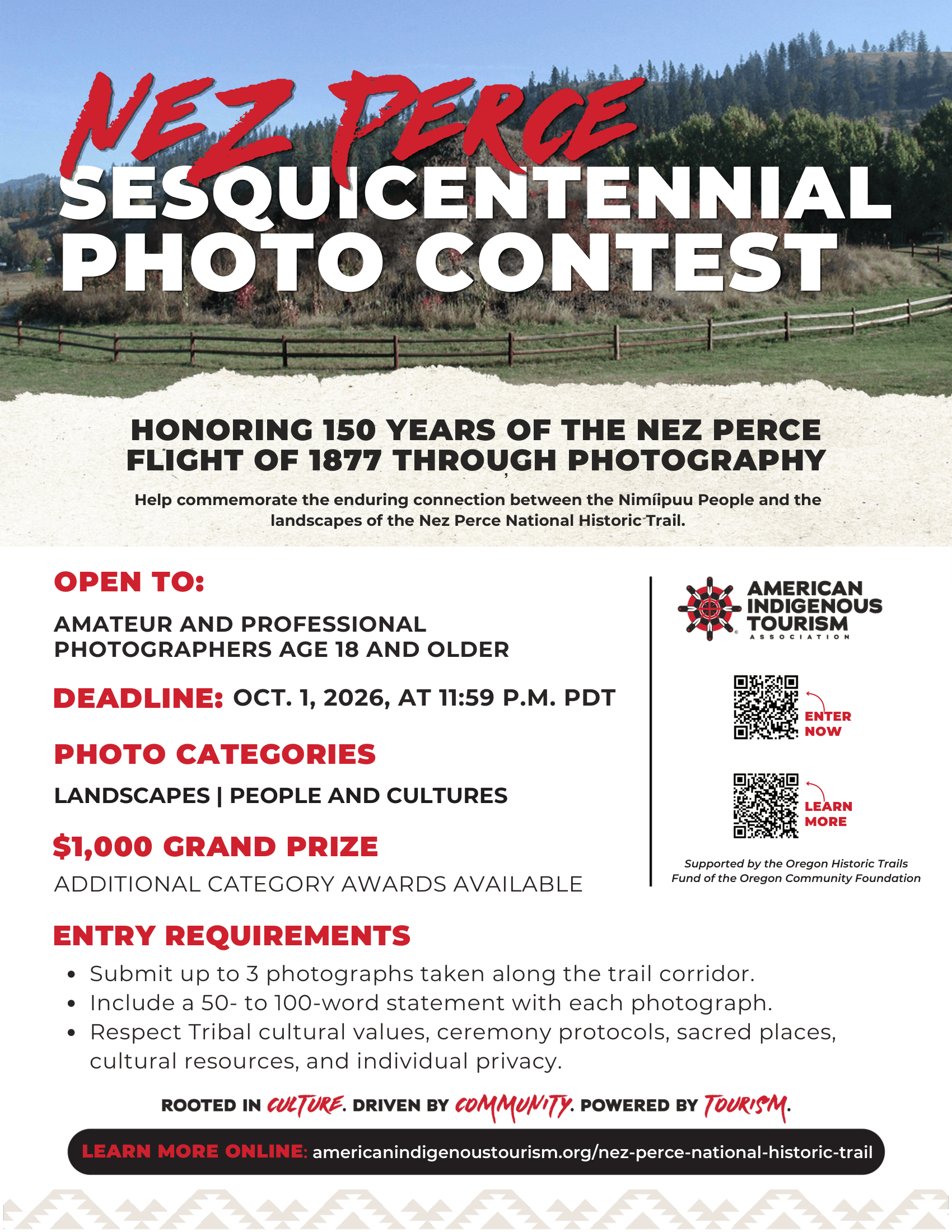
Download the contest overview for categories, entry requirements, and additional information.
Nez Perce National Historic Trail
American Indigenous Tourism Association Partnership
American Indigenous Tourism Association and the USDA Forest Service (USFS) have partnered to expand tribal tourism along the Nez Perce (Nee-Me-Poo) National Historic Trail (NPNHT). This initiative supports economic development, cultural preservation and public engagement by amplifying tribal perspectives.
American Indigenous Tourism Association will collaborate with tribes to create itineraries, content and marketing resources that highlight Nez Perce history, culture, and Trail sites. Key projects include a pop-up interpretive exhibit, public art installations, travel itineraries and listing tribal attractions and accommodations on American Indigenous Tourism Association ’s destination website, destinationnativeamerica.com.
Aligned with the NATIVE Act, this project contributes to the NPNHT’s sesquicentennial observance (1877-2027), ensuring that tribal voices remain central to the Trail’s narrative for future generations.
Nez Perce Sesquicentennial Photo Contest
Honoring 150 Years of the Nez Perce Flight of 1877 Through Photography
Photographers are invited to help commemorate the 150th anniversary of the 1877 Flight of the Nimíipuu (Nez Perce) through images that reflect the landscapes, history, and living cultural connections of the Nez Perce (Nee-Me-Poo) National Historic Trail. The contest is open to amateur and professional photographers age 18 and older.
Entry Deadline: Oct. 1, 2026, at 11:59 p.m. PDT
Photo Categories
Landscapes
Historic places and scenic landscapes along the Trail, including rivers, prairies, mountains, valleys, and vistas.
People and Cultures
Community gatherings, commemorative events, intergenerational storytelling, contemporary Indigenous culture, and connections to the Trail.
Prizes
Grand Prize: $1,000
Category Awards:
First place: $500
Second place: $250
Third place: $150
Entry Requirements
Photographs must be taken along the Nez Perce National Historic Trail corridor. Each submission must include a 50- to 100-word statement describing the image’s historical, cultural, or personal significance. Participants may submit up to three photographs, and Tribal affiliation may be included on the entry form.
Cultural Respect
All submissions should honor tribal cultural values and respect ceremony protocols, sacred places, cultural resources, and the privacy and dignity of individuals and communities.
Supported by the Oregon Historic Trails Fund of the Oregon Community Foundation.

Nez Perce National Historic Trail (NPNHT) History
The Nez Perce National Historic Trail, a 1,170-mile route, traces the 1877 flight of the Nez Perce people as they fled U.S. forces. Designated in 1986, the Trail commemorates their resilience. Beginning at Wallowa Lake, Oregon, it crosses into Idaho, following the Clearwater and Lochsa River before reaching Montana at Lolo Pass. The route continues through the Bitterroot Valley, over Gibbons Pass, and into the Big Hole Valley, the site of a tragic battle. It then crosses back into Idaho, traverses the Birch Creek and Lemhi Valleys, re-enters Montana, passing through Yellowstone National Park and concludes at Bear Paw Battlefield, Montana.
The Trail's route is defined by the Nez Perce's journey with approximately 750-800 people, 2,000 horses, and hundreds of dogs, traveling for over 110 days. Five distinct Nez Perce Bands, sometimes traveling together, sometimes separately, were pursued by the U.S. Army, which also took varied routes. This complex movement makes it impossible to define a single, definitive path.
The Nez Perce, or Niimíipuu, have inhabited the region for over 11,000 years, moving seasonally. Their society was organized into autonomous bands. The acquisition of horses around 1700-1730 significantly impacted their culture, enhancing mobility and trade. Early contact with European-Americans, including the Lewis and Clark Expedition, was followed by the fur trade and missionary activity. Increasing settler encroachment led to conflict and broken treaties, culminating in the 1877 War.
The war began with engagement between Nez Perce warriors, the U.S. military and area settlers. The ensuing flight saw the Nez Perce evade the army across vast distances. After the Battle of the Big Hole, they continued their arduous journey toward Canada. Intercepted near the border, Chief Joseph surrendered, marking the end of the flight. The survivors were not returned to their homeland but were instead imprisoned at Fort Leavenworth, Kansas. Chief Joseph became a powerful advocate for his people, eventually securing their return to the Northwest. Chief Joseph later died and is buried on the Colville Reservation.
Today, the Nez Perce Trail traverses diverse landscapes, crossing traditional homelands of numerous tribes. While some areas have changed, the landscape retains its beauty. The Trail is divided into eight segments for administrative purposes, corresponding to auto tour routes from from the vicinity of Wallow Lake, Oregon, to Bears Paw Mountain, Montana. Managed by the U.S. Forest Service, the Trail's purpose is to preserve and interpret the history of the Nez Perce flight, foster collaboration and provide educational and recreational opportunities.
Source: USDA Forest Service 2020 Comprehensive Plan
Resources

Agents of Discovery: App Engages Youth Along Historic Trails in Bitterroot
The Agents of Discovery mobile app brings history, nature, and culture to life through immersive, educational augmented reality experiences along the historic trails of the Bitterroot Valley. Guided by Discovery Agent Itse-Ye-Ye—“Coyote” in Nez Perce—youth and families can embark on site-specific “missions” at places like Lake Como, River Park, St. Mary’s Mission, and Travelers’ Rest State Park. Dressed in traditional regalia, with a fan, shawl, corn husk bag, and shell earrings, Itse-Ye-Ye serves as a cultural guide, sharing stories and prompts that encourage movement, curiosity, and deeper understanding of the land and its heritage. This free app is designed for students in fourth grade and above, but offers engaging, gamified learning for all ages—helping to preserve cultural knowledge, strengthen connections to place, and inspire the next generation of explorers.

The Nez Perce (Nee-me-poo) National Historic Trail
Congress passed the National Trails System Act in 1968, establishing a framework for a nationwide system of scenic, recreational, and historic trails. The Nez Perce (Nee-Me-Poo) National Historic Trail stretches from Wallowa Lake, Oregon, to the Bear Paw Battlefield near Chinook, Montana. It was added to this system by Congress as a National Historic Trail in 1986. The Nez Perce (Nee-Me-Poo) National Historic Trail stretches from Wallowa Lake, Oregon, to the Bear Paw Battlefield near Chinook, Montana. It was added to the National Trails System by Congress as a National Historic Trail in 1986. The Forest Service manages and cares for many National Scenic, Historic, and Recreation Trails with the help of countless volunteers and partners.